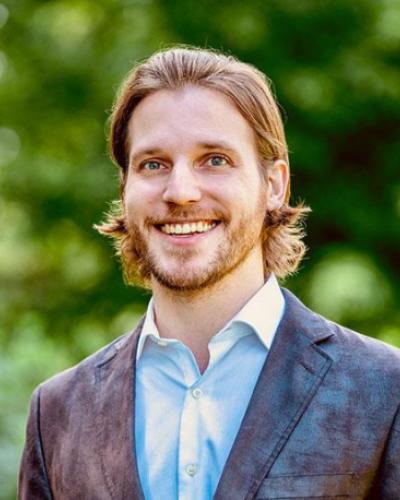
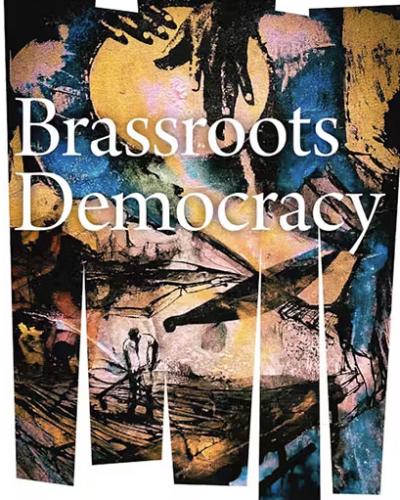
The Fellows’ Q&A series continues with a spotlight on Benjamin Barson. Barson is the Samuel L. Williams Endowed Assistant Professor of Music at Bucknell University and former Mellon Postdoctoral Fellow in Africana Studies and Research Center at Cornell University. His book Brassroots Democracy, evolved out of research during the Fellowship year.
Big Picture:
For nearly a century, the utopian gestures heard in jazz have attracted a wide range of interest—from political activists to modernist intellectuals to theorists of the African diaspora. My own interest in the emancipatory potential of African American improvised music deepened during my twenties, when I worked with a number of radical musician-organizers in New York City. Many had come out of the Black Arts Movement, the late-1960s upsurge of community-oriented, grassroots arts spaces that explicitly sought to decolonize everyday life through innovative pedagogy and the performance of African American music.
As I began my graduate studies at the University of Pittsburgh years later, I began to trace these musical experiments in community-led arts and activism to an earlier period: that of jazz’s development in turn-of-the century New Orleans. Second-line parades and jazz funerals are well known, but I was excited to see in newspapers, and hear in interviews with jazz musicians, how frequently the city’s Black labor movements—especially those of longshoremen and dockworkers—were sustained by insurgent music making in the streets and in union halls. I began to suspect that brass band parades—popular associations animated by communal, and sometimes improvised, music—“remixed” earlier forms of struggle. I call this pantheon of brass band activism and the generation of new counterpublics “brassroots democracy.” As I studied nineteenth-century movements against colonialism and slavery in the Caribbean basin, I began to situate brassroots democracy’s emergence within a milieu of Black Reconstruction political activists, amongst whom the lessons and memories of the Haitian Revolution loomed large. Many important early jazz musicians, I soon learned, were not only the children of this cadre of Black Reconstruction activists, but also second or third generation Haitian-Americans. From the Haitian Revolution to Louisianan Reconstruction, I started to hear how Black brass bands infused participatory music practices with radical democratic ideals. The book, then, challenges the conventional narrative of jazz that frames the music as a cultural bridge between Africa and Europe. Instead, I foreground its deep intra-Caribbean and Black Atlantic entanglements—particularly its connection to the Haitian Revolution, the maroon societies of Louisiana and the US-Mexican borderlands, and Black struggles for democracy during and after Reconstruction.
The stakes of this work are both historical and contemporary. Jazz is often celebrated as “America’s classical music” and a metaphor for democracy, yet its early practitioners were much more ecumenical, cosmopolitan, and Atlantic than that phrase suggests. In a way, Brassroots Democracy shows how entrenched Black internationalism was, at an earlier period than historians of Black Radical Tradition often account for. Understanding this history reclaims jazz as a site of resistance and communal self-determination, what I hear as a kind of communitarian alternative to plantation capitalism proposed by the survivors of slavery and their descendants.
In Particular:
The book tries to make two interventions in the field of jazz studies and New Orleans studies. One, as I have laid out, is the intra-Caribbean routes of early jazz, the musicians and communities who first developed its insurgent soundscape. The second, closely related, intervention can be broadly surmised as: is it possible, or desirable, to discuss a musician without their other commitments? In my research in the Hogan Jazz Archive’s oral history database at Tulane University, it was striking to me how important the working experiences of musicians were—outside of their musical labors, that is. Clarinetist Willie Parker was a dockworker who was so involved in the Black labor movement that he participated in the mammoth 1907 strike which crippled the New Orleans mercantile bourgeoisie. He even supported the attacking of scabs laborers who were recruited by shipping bosses to break the will of the strikers.
These thick social and labor histories also informed the transnational connections that brassroots musicians developed. Famed New Orleans clarinetists Lorenzo and Louis Tio were born on a commune in Veracruz, Mexico, in the early 1860s. Their parents, along with other New Orleans free people of color, were invited to form the “Eureka Colony” by Zapotec Indigenous President Benito Juarez who worked as a cigar roller in New Orleans. He may have rolled alongside the Tios’ parents, who themselves later worked as cigar rollers in Tampico, Mexico, until moving back to New Orleans in 1877. In fact, a quarter of early jazz musicians listed their occupation as “cigar roller.” Simply put, the line demarcating longshoreman, volunteer firefighter, civil rights activist, and cornetist was thin or nonexistent, and hearing the music as a transliteration of what happened on the docks, or amongst striking sex workers in Storyville, makes its ability to create and accompany large-scale assemblies all the more potent. Can you imagine thousands of Black paraders singing and jamming a song about a corrupt boss during a Labor Day parade? That kind of moment, I think, needs to be enveloped in the larger ensemble of quotidian commitments, the common-sense of the era. And so, the book challenges the (bourgeoise) idea that the music was a kind of “universal language,” somehow disconnected from the realm of the everyday, the all-too-human, struggles over power and socio-political autonomy.
Discovery:
One of the most exciting discoveries in my research was uncovering a 1958 recording of Alice Zeno, the mother of a famous clarinetist named George Lewis (no relation, to my knowledge, to the trombonist and composer and AACM alumnus George Lewis). Zeno sang a song in Haitian Creole during this interview that had been passed down in her family since the mid-nineteenth century. Zeno, whose parents and grandparents had been enslaved, related that this song was from the Haitian Revolution, although it appears to reference the overthrow of Haitian Emperor Faustin Soulouque by President Fabre Geffrard in 1858. How this song reached Zeno’s ancestors, and why they chose to sing it for a century, is something the book tries to unpack. In addition to former SHUM fellow Leslie Alexander’s fantastic Fear of a Black Republic, which traces the influence of the Haitian Revolution amongst enslaved and free Black communities in the nineteenth century, I also found Julius Scott’s ideas in The Common Wind quite compelling. Scott identified a “transatlantic news pipeline” that shared news of the Haitian Revolution amongst “free coloreds . . . [who] tested the limits of their masterless status.” He coined this regional network of communication as “the common wind.”
Fellowship:
My year at the Society for the Humanities was transformative for this project. The theme of “Crossings” encouraged me to think more expansively about the transnational movement of people, sounds, and political ideas that shaped early jazz. These crossings—between the Caribbean and the Gulf Coast, between revolutionary ideologies and musical forms—lie at the heart of my book. Being in a truly interdisciplinary environment deepened my understanding of these intersections, and the possibilities afforded by them. One colleague in particular, Emma Campbell, provided invaluable feedback on my introduction, helping me restructure a chapter that had become overly labyrinthine. The generous critiques and curiosity of the whole cohort pushed me to sharpen my arguments and articulate their significance beyond the field of jazz studies.
Midway through the fellowship year, I submitted the completed proofs of the book, which gave me the opportunity to begin work on a standalone article. This piece emerged from a thread in the book that had felt underdeveloped: the relationship between early jazz, “brassroots democracy,” and the history of marronage—that is, the organized, often clandestine, exodus from slavery. In collaboration with historian John Bardes, I returned to New Orleans’s antebellum police archives and uncovered new evidence suggesting that musicianship was central to these networks of fugitivity and resistance. Clarinetists, in particular, appear in surprising places—and the police records we sifted through pointed to a kind of sonic underground, populated by enslaved musicians, free people of color, and occasionally white audience members. That is, maroons held jam sessions, and a lot of them. My time at the Society helped me clarify the material conditions of this musical marronage: How were clarinet reeds shared or traded? What kinds of informal production systems sustained these cultural practices in the swamps and outskirts of antebellum Louisiana? What was at stake in performance in these conditions of social death?
The resulting article, “Maroon Resonance: Fugitive Ecologies of Sound and Jazz Spatiality,” will be published later this year in Jazz & Culture. It would not have taken the shape it did without the intellectual provocations of the “Crossings” theme and the support of the Society community.