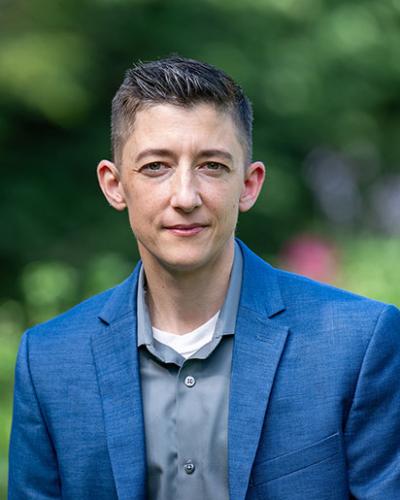
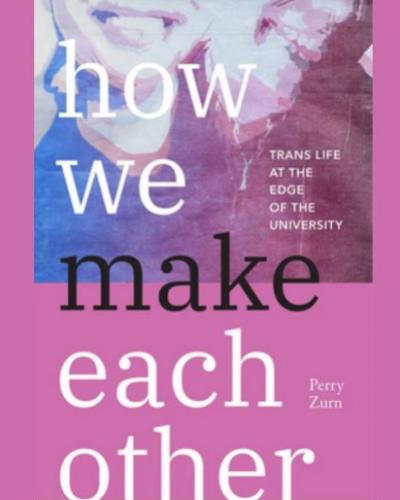
The Fellows’ Q&A series continues with a spotlight on Perry Zurn, Provost Associate Professor of Philosophy at American University and former Society for the Humanities Fellow at Cornell University. His book, How We Make Each Other: Trans Life at the Edge of the University, evolved out of research during his Fellowship year during the theme of "Crossing."
Big Picture:
Fresh from my PhD in 2015, I landed my first job as Visiting Assistant Professor at Hampshire College, a kooky small liberal arts school situated in the idyllic Connecticut River Valley, in Western Massachusetts. What made the biggest first impression was not how many students wore brightly dyed hair or how often faculty dropped the word “radical” in school meetings. It was the bathrooms. They were all gender inclusive. How, my mind desperately pleaded. I determined then and there to dig up the trans story at Hampshire College—an ambition that quickly spiraled out to encompass the other members of the Five College consortium: Amherst College, Mount Holyoke College, Smith College, and University of Massachusetts, Amherst.
Over the next six years, I dove repeatedly into local and college archives. I also conducted 78 interviews with trans and allied students, staff, faculty, and alums (and relied on dozens more from the Trans Archive Oral History Project at Smith). Slowly, it dawned on me. The story most worth telling here was not that of trans policies—or how trans inclusion became instituted in the university. Rather, the story most worth telling was the story of trans poetics—the way trans people make each other possible and thinkable, palpable to the skin and sensible to the heart, often at the edge of the university and even despite it. Instead of focusing on markers of neoliberal inclusion and individual rights, then, I zeroed in on trans tactics for making history, building resistance, and cultivating hope. How We Make Each Other: Trans Life at the Edge of the University is the result of that journey.
In Western intellectual thought, the term poetics—stemming from the ancient Greek poeisis—refers not only to the specific craft of making poetry but also to the generalized craft of making or fabricating anything at all. For poet and theorist Fred Moten, poetics captures not policies or institutional formulae, but rather modes of living at the margins. Poetics, for him, marks how people in the “undercommons” “make things and make one another.” Taking inspiration from this expansive tradition, How We Make Each Other draws a multifaceted description of trans poetics from the ephemera and oral histories of trans people themselves—living and working, loving and struggling in the cracks of the university.
In Particular:
The book’s attunement to trans poetics intervenes within a literature otherwise focused on trans inclusive policies in higher education. The book’s analysis of trans history, trans resistance, and trans hope, moreover, intervenes in the long philosophical traditions of theorizing these terms in universal, dehistoricized, and uprooted ways—where trans people are never thought to matter, and often thought not to exist.
Yet another key intervention of the book, however, is methodological. This is a work of story-led theory. I am a trained philosopher. In philosophy, stories typically get used as examples of the theory, or applications of the theory, or intuition pumpers of the theory. But an unstoried theory remains paramount. In this project, I am politically committed to trans stories leading trans theory. And, more than that, I am committed to showing that trans stories are already mobilizing trans theory. But this is also a work of place-based theory. One manuscript reviewer was alarmed that they didn’t see “all the big names in trans theory” populating its pages. “Your readers will want to see those names,” they told me. I consciously chose, however, to focus on trans theorists and creators who were local to or had intersected with the Five Colleges themselves. I wanted to use local theory for a local project. I wanted to garden within a philosophical ecology rather than (re)crown philosopher kings. As a work of place-based story-led theory, then, this book is a love letter to the people I met, the words they shared, and the ground on which they stood.
One of my favorite stories in the book is of the pebble protest at Hampshire College. In the aughts, students agitated for queer and trans affinity housing. They advocated for it as part of a larger project to address various forms of institutionalized racism, sexism, and homophobia on campus. Pragmatically speaking, the students gathered everyday outside of the college president’s door and left a pile of pebbles on the floor. The same fifteen to twenty people, and every day the same pile of pebbles. Reportedly, he was furious. How inconvenient to greet a pile of pebbles as you enter and exit your office! But that pile of pebbles was no mere cause of aggravation. It was also a performance of the request itself. Queer and trans students wanted to chink together, to tumble around together in a shared riverbed. They wanted to rest together but also sharpen each other. They wanted to make each other. To me, the pebble protest beautifully underscores the importance of building space together—conceptually and materially.
Discovery:
It happens all the time with archival work. You find something you were not looking for—something you may never have even thought to look for—and that something becomes everything. One fateful week in 2018, I spent several days shuttling my body to the tippy top of the W.E.B. Du Bois Library, at UMass, to shuffle through a wall of unprocessed archive boxes from the campus’ Stonewall Center. It was there that I encountered the curious records of Enoch Page—to my knowledge the first out trans professor at the Five Colleges. Hired in the 1980’s with a specialization in race and anthropology, Page worked at the intersection of Black, queer, and trans life before it even had a name (and fieldly parameters). In a deeply white, heterosexist institution, that was an uphill battle—enough that Page left before earning proper retirement.
By some feat of social media, I got in touch with him. He shared with me his gender journey. As a Black trans man, he had been approved for a sexual reassignment program as early as 1971. He told me of the overt and covert racism he faced in the academy—from top to bottom. And he spoke to me about the importance of healing and spirituality. Then he told me about his current work curating an online exhibit of BIPOC Trans Spiritual Leadership. It was the sort of project that situated his own gifts within a longer history—one rarely told. As I listened, I realized that what surprised me most was not that I had found him in the archives, or again in real life, but how much I needed his wisdom. How much we all need it.
I started collecting interviews and archival material for this project in 2017, at the beginning of Trump’s first presidency. The book came out this past January, just in time for his second presidency. As fate would have it, I wrote the book I needed to read this spring. I needed to read about trans people making space together. I needed to read about how to fight hard and to rest hard, how to hurt and to heal. I needed to read a book where trans honesty and humor commingled. And where trans people modeled a higher calling in the midst of a world that expects little of us and often wishes we weren’t there. Ultimately, I needed to read a book where I could meet Page again and again. And somehow, it is here now, in my hands.
Fellowship:
My year at the Society was fantastic. There is a kind of magic that can only happen when you sit at the confluence of two or more bodies of water. Something happens between the ears and the eyes, between the surface and the deep, along the currents of the wind. The same can be said of two or more bodies of knowledge. The uniquely transdisciplinary conversations I witnessed—and occasionally helped make—at the Society left an indelible mark on my writing, both then and thereafter. Sure, we can drop into multidisciplinary spaces wherever we are, any given year, but there is something about the stark locatedness of a small cohort, in a small room, gathering week after week, that magnifies everything—the friction of fine details and the almost addictive reverberations across topographies. A favorite example: I was theorizing stones (real and metaphorical) in trans studies, when Emma Campbell started talking about firestones in medieval bestiaries and their strange torsion of the (properly sexed and gendered) human. Sparks flew!
Speaking of rocks, sometimes I live under one. I arrived at Cornell in the fall of 2023 without knowledge either of the Human Sexualities Collection or of its fabled caretaker, Brenda Marston. Weirdly, it took an unrelated call to a gay elder in Philadelphia to send me scurrying into the double basement of Olin Library to search out local queer history. That was almost two years ago now, and I have yet to stop. I credit (blame?) the riches of that archive for now several new book projects. The first, Cisgender: Disorienting a Category (Duke), comes out next year!
Of all the fellows with whom I shared that year, I was perhaps most influenced—or changed—by Kim Eitzen-Heines. Kim had just recently published her book Sonorous Desert: What Deep Listening Taught Early Christian Monks and What It Can Teach Us. What stopped me—stunned me even—was in fact the way Kim listened. Never the first to speak and often quick to give up her spot in the queue so that others could speak (sometimes for the second or third time), she listened. Her face always intent, a strange mixture of right here and very far away. And when she did speak, it was as if she had perched at the mouth of a well. She spoke like someone who makes a habit of watching, someone who makes a habit of catching echoes as they happen. One day, as we were all talking about methodological conundrums in our writing, she asked the stunningly simple question: “What do we (over)simplify in order to complexify something else?” A sticky question that has stuck with me (and stuck to me) ever since.
A year at the Society is a mobile treasure.