Announcing the 2026-27 Fellows at the Society for the Humanities:
Durba Ghosh, Taylor Family Director
Society for the Humanities Visiting Fellows
Lucy Alford
English, Wake Forest University
Vital Signs: Precarity in Poetic Form
J. Andrew Dufton
Archaeology, Dickinson College
The Neighborhoods of Ancient North Africa
Amanda Gaggioli
History, University of Memphis
The Politics of Resilience: Earthquakes and Terraces in the Structuring of Greco-Roman Society
Ungsan Kim
Asian Languages and Literature, University of Washington
Future Imperfect: Queer Asian Cinema and the Temporality of Survival
Jérémie Foa
History, Aix-Marseille University
Surviving in the Renaissance: Facing Violence and Climate Change in the Late Sixteenth Century
Rei Magosaki
English, Chapman University
Poetics of Japanese American Incarceration Literature
Society for the Humanities Faculty Fellows
Jamie Budnick
Sociology, Cornell University
CARRYING CAPACITY: On (Not) Parenting in the Era of Climate Change
Pamela Karimi
Architecture, Cornell University
Survival by Design: Desert Architecture at the End of the World
Kristin Roebuck
History, Cornell University
“Minor Islands” of Survival: War, Internment, and Collaboration in the Japanese American Pacific
Ivanna Yi
Asian Studies, Cornell University
Multispecies Diaspora: Survival and More-than-Human Kinship in Korean Literature
Mellon Graduate Fellows
Aditi Shenoy
Literatures in English
Beyond Survival: Aspiring to Wholeness in the African Novel
Elexis Trinity Williams
Science and Technology Studies
Menfish, Mermaids & Aquanauts: Scientific Diving and the Evolution of Cold War Hybridities in American Oceanography, 1943-2027
Mellon Postdoctoral Fellows
Clay Davis
Science and Technology Studies
Moizza Elahi
History of Art & Visual Studies
Amanda Martin
History
Jorden Sanders
Literatures in English
Humanities Scholars Program Postdoctoral Associates
Jennifer Rabedeau
Literatures in English
Salma Rebhi
Romance Studies
2026-27 Focal Theme: Survival
We invite humanistic engagement on what it means to live in moments that are marked by precarity, fragility, and catastrophe. What might it mean to flourish in a world on the brink of extinction or exhaustion? Survival can be individual or collective, shaped by cultural imperatives, ideological commitments, or existential negotiations in the face of political, economic, environmental, social, and technological upheavals. Under these conditions, survival is more than living: survival can be a form of living on, a form of sustenance. We ask: what practices and imaginaries survive as individuals, movements, or species confront erasure? How does sudden or slow violence produce ways of surviving? Is refusal, dissent, resilience, or renewal sufficient to counter destructive forces?
We draw inspiration from ideas about “survivance,” and ask what it means to endure and transform amid the catastrophes (past and present) that challenge our existence. As Audre Lorde asks, what does it mean to craft a good life in a world structured so that some were never meant to survive? Have our visions of the good life become sources of cruel optimism, to follow Lauren Berlant?
In posing these questions, we invite humanistic research that engages or critiques the idea of survival. From environmental challenges (hurricanes, floods, droughts, wildfires, famine, and rising sea levels) to political landscapes (wars, military action, regime change), we invite research that considers survival through questions of poetics, aesthetics, ethics, history, or biopolitics. Could we rethink the literary, material, psychic, and symbolic survival of the past? Is one avenue for survival to embrace the fugitive possibilities of living on amongst the ruins? We welcome projects that collectively press us to confront the survival of care, creativity, freedom, prosperity, and knowledge.
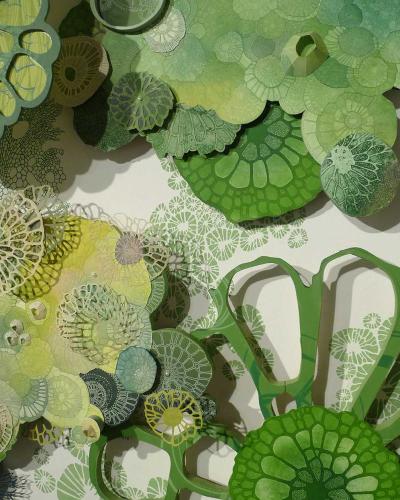
Image: Coral Confection, Lauren Kussro, www.laurenkussro.com.